OFDI diagnostics: When to consider different types of OFDI policy
While many countries have substantial OFDI outflows and numerous multinational enterprises investing internationally, the composition and patterns of OFDI can differ considerably from country to country, with corresponding variation in the home-country effects generated in each country. These differences in the form and degree of OFDI impact mean that OFDI policy will have to vary as well, adapting to each economy’s specific conditions and stage of development.
It is therefore important to consider when and how to use OFDI policy and HCMs to nurture specific kinds of home-country effects, and thus when and how to draw on this Toolkit for the purpose of developing appropriate OFDI policy. There are three diagnostic steps that can help countries determine when and how to advance OFDI policy and introduce HCMs in line with the conditions, characteristics and developmental stages of their economies (Stephenson 2018a). Ideally, these diagnostic steps should be examined in the proposed order.
1. Readiness assessment
First, governments can undertake a general assessment on the extent to which the country is at the right stage to advance OFDI policy. This ‘readiness’ will vary, in particular, by stage of economic development of the home country and the extent of actual or expected OFDI flows. There are several ways to evaluate whether a country is ready for advancing OFDI policy and introducing HCMs:
a) Degree of economic development
Upper middle-income and high-income countries account for the vast majority of OFDI, as they have comparatively high capital availability and more firms with capabilities and competitive advantages that enable them to invest abroad. This means that, among developing countries, the emerging economies and upper middle-income countries are likely to experience considerable levels of OFDI, requiring their governments to consider OFDI policy. Nevertheless, despite being more constrained in their availability of capital and having a relative shortage of internationally competitive companies, many lower-middle income and low-income countries do have firms that invest in other countries, so that at least a basic OFDI policy could be considered here as well.
b) Stage in the investment development path
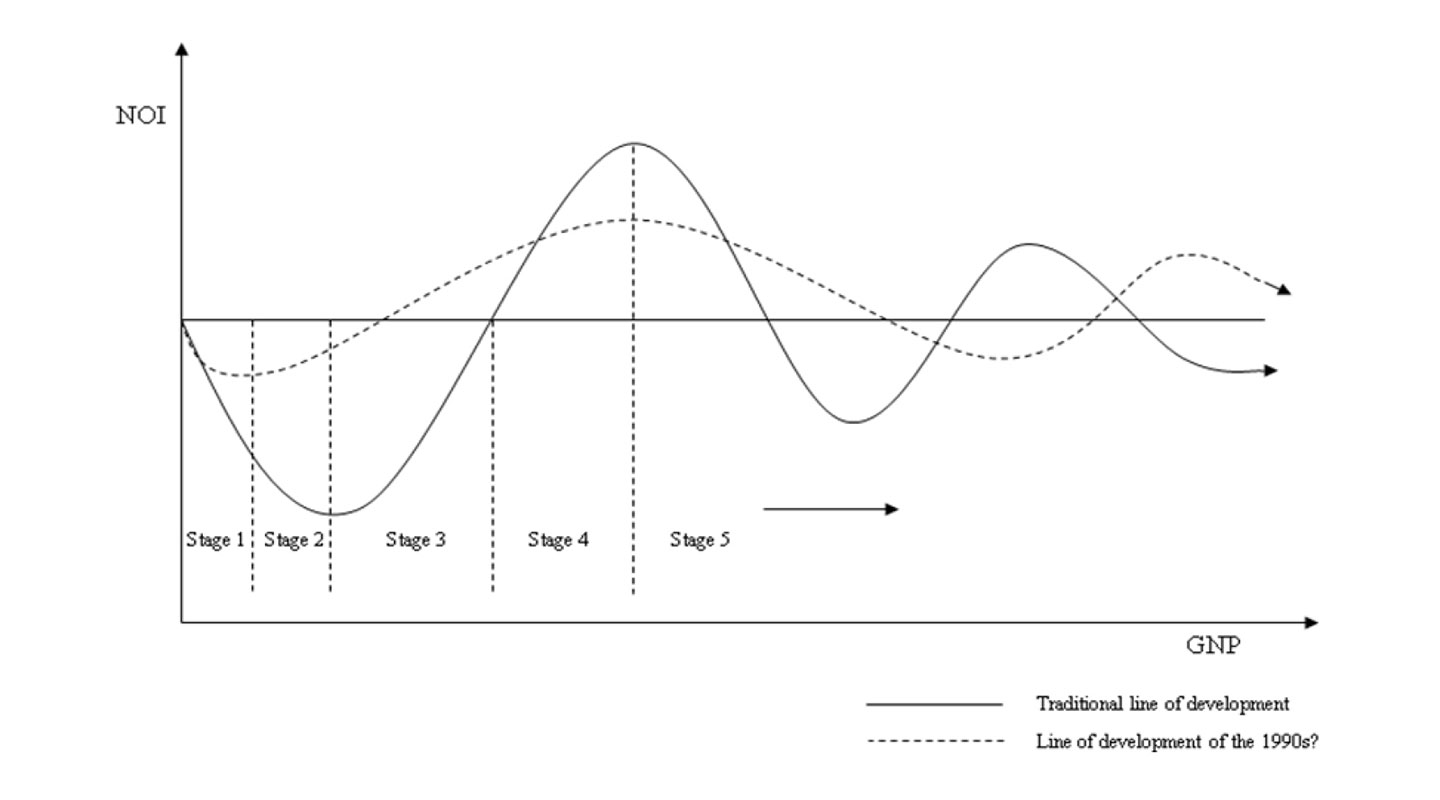
The investment development path (IDP) illustrates the different stages countries are in as sources and recipients of investment. A key indicator is the relative ratio of inward and outward investment of a country, measured as net outward investment (NOI), which equals a country’s OFDI stock minus its inward foreign direct investment stock (Dunning and Narula 1996). The IDP, as represented graphically in Figure 5, has been frequently used to explain how countries move from being primarily capital importers to engaging in greater levels of outward investment.
Figure 5 Graphical representation of the IDP
Source: Dunning and Narula (1996)
While countries in stage 1 primarily experience increases in inward investment, from stage 2 onwards they begin to gradually have some OFDI as well, which may be increasing rapidly but from a low base. Accordingly, governments of countries in stage 2 could begin to consider introducing policies concerning OFDI, in anticipation of it growing in the future. As countries move from stage 2 to stage 3, their NOI reaches its nadir and then starts to grow, increasing substantially in stage 3, when OFDI growth outpaces that of inward investment. Therefore, any economy at stage 3 or above with a growing NOI is prima facie a promising candidate for having a dedicated OFDI policy and introducing considered HCMs.
c) Strong OFDI indicators
When a country’s indicators on levels of capital outflows suggest that it is, or will become, an important source of OFDI, there is likely a need for an OFDI policy and the introduction of appropriate HCMs. A simple indicator would be a country’s absolute levels of OFDI, although this can be a fairly crude way of measurement.
Another, more nuanced indicator is a country’s rate of growth of OFDI over the previous few years. Any country where the growth rate of OFDI is increasing is prima facie a viable candidate for having an OFDI policy. This can even be the case when a country is still in stage 2 of the IDP, experiencing a diminishing NOI due to even higher growth rates of inward investment, yet the contemporaneous presence of high OFDI growth rates would suggest a need for considering OFDI policy and HCMs.
A third indicator can be the ratio of a country’s OFDI to its GDP. This statistic is insightful as it examines OFDI levels relative to the size of the home country’s economy. It might, for example, pick up small countries with relatively high levels of OFDI/GDP, even if their absolute volumes of OFDI stock are not considerable.
d) Benchmarking with comparable countries
Countries can assess the need for an OFDI policy and the introduction of HCMs through comparisons with other countries. Such benchmarking can be helpful to assess a country’s relative exposure to OFDI compared to peers. This test could involve a small sample of comparative countries, such as regional neighbours or countries with similar contexts and characteristics in terms of size, industrial structures, stage of economic development etc. The comparison would draw on several data-points, including the size of OFDI flows and stock, the growth rate of OFDI flows and stock and the share of OFDI stock as a percentage of GDP. If a country exhibits significantly lower levels of these metrics compared to other similar countries, and the government sees the need to catch up with its peers in this area, the country is prima facie a candidate for OFDI policy.
e) Inclusion of OFDI in the national development strategy
Finally, if a government has included OFDI in its national development strategy and incorporated OFDI into strategy documents, masterplans etc., it would be reasonable to have an OFDI policy and introduce HCMs to support this strategy.
2. Stage in OFDI policy path
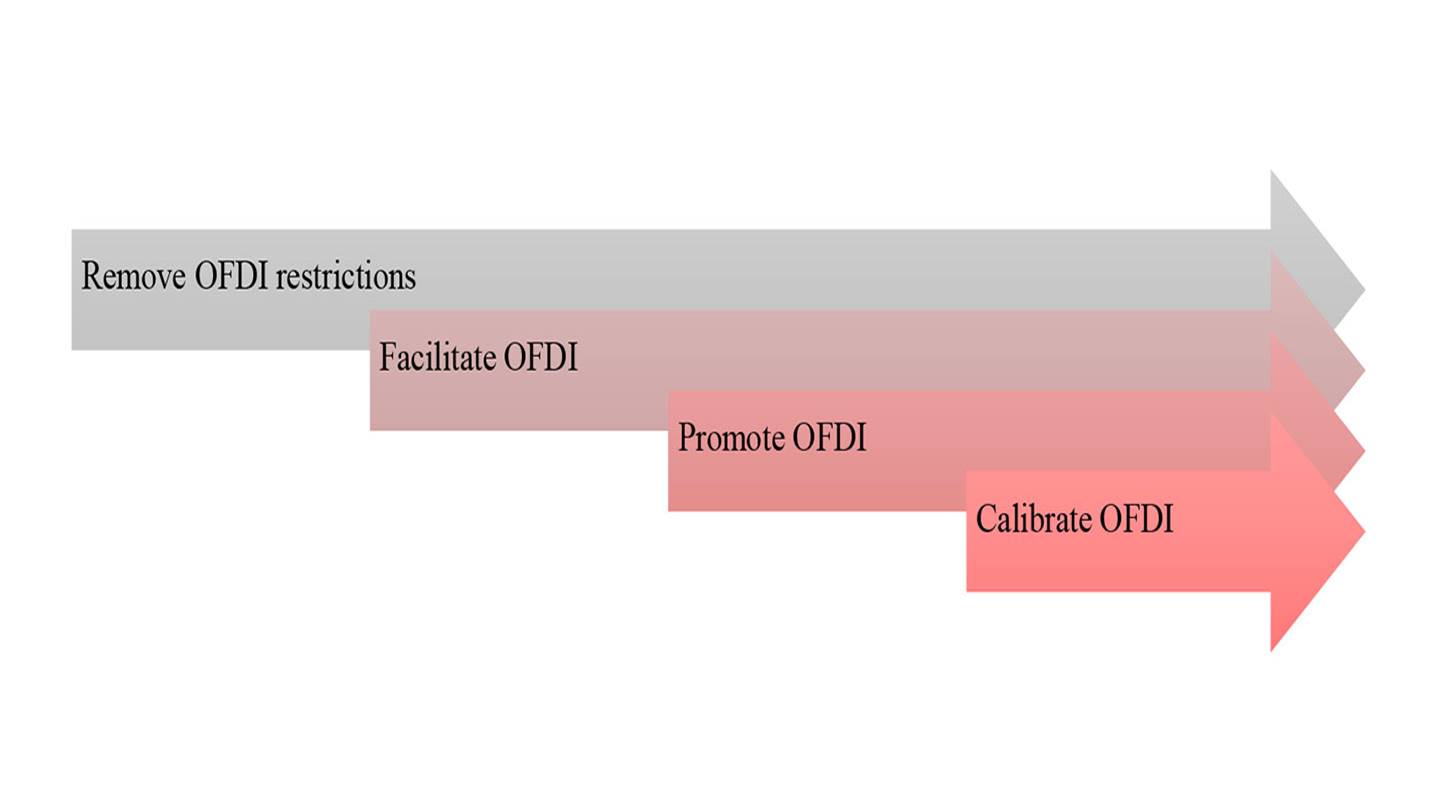
A second diagnostic step involves identifying where a country is on the OFDI policy path (Stephenson 2021), as shown in Figure 6. The OFDI policy path describes a sequence of stages that countries can follow when identifying appropriate OFDI policy requirements and HCMs, with generally increasing levels of OFDI support (as listed in Section C: Home-country Measures).
Figure 6 The OFDI policy path
Source: Stephenson (2021)
Governments and policymakers often begin by removing restrictions on OFDI, such as approval procedures, outright bans on OFDI or foreign exchange restrictions (see C2) Regulations). The next stage is often the facilitation of OFDI, for instance by providing information, advice and other early support services to companies that are considering investing abroad (see, for example, C3) Early support services). Then governments might begin to offer more complex and resource-intensive forms of support and develop what can be considered active OFDI promotion. OFDI promotion can range widely, from political risk insurance (see C6) Political risk insurance), signing treaties (see C7) Treaties), offering support in establishing subsidiaries abroad (see C8) Operational support) to financial and fiscal incentives (see C4) Financial support, C5) Fiscal support). Normally, countries will keep the measures adopted in earlier stages while adding new ones when entering the next stage of the policy path (Stephenson 2021).
Finally, once countries have gone through the first three stages of the policy path, their governments may identify a need to re-calibrate their OFDI policies and measures as OFDI patterns evolve, by changing levels of restriction, facilitation, and promotion, and tailoring them more towards different forms of OFDI. This re-calibration can involve greater efforts at targeting specific types of companies or investment activities (see Section D: Targeting). It might even involve removing some existing measures.
It is important that measures adopted at any stage of the OFDI policy path conform with specified sustainability criteria, especially regarding the sustainability performance of multinationals when they operate abroad (see under C2) Regulations). In other words, sustainability is not an aspect that should be introduced at a later stage but should be an important consideration from the outset when countries first start introducing HCMs.
Not all countries follow the OFDI policy path in exactly the same way and at the same speed, and some may be more proactive in introducing and developing OFDI policies and measures, while others might be rather passive at first and then accelerate several stages within a short period of time. The Toolkit can inform the appropriate selection of OFDI policy and HCMs taking into account the stage a country is already at on the OFDI policy path, while taking into consideration the particular economic and political circumstances of the country, its national development strategy and its position on the IDP.
3. Identification of appropriate HCMs
Once ‘readiness’ for OFDI has been established and a country’s stage in the OFDI policy path identified, it is possible to use the Toolkit to identify the appropriate next steps in the development of OFDI policy and the use of HCMs. In particular, three five considerations should be made:
a) Affordability considerations
Most HCMs come at some cost, and a government needs to consider affordability of each measure before its implementation. These affordability considerations should take into account the considerable variations between the costs of specific HCMs – some are a lot more expensive and bureaucratic than others. The value for money of each HCM, i.e., the prospective gains from the measure compared to its costs, will also need to be taken into account, and will depend on considerations such as the country’s readiness for OFDI, its position in the OFDI policy path, expected beneficiaries of these measures, anticipated home-country effects, the country’s broader economic policy etc.
b) Removal of restrictions
Generally, the considered removal of OFDI restrictions would be an important prerequisite for the development of further OFDI policies and HCMs. Restrictions may prevent OFDI from generating home-country effects and lower an economy’s investment competitiveness. Thus, any OFDI restrictions that are retained should be informed by clearly specified development objectives, and these objectives should be accomplished with the least onerous and distortionary restrictions possible.
c) Match with a country’s stage in the OFDI policy path
An OFDI policy and appropriate HCMs should be chosen so they match with the country’s stage within the OFDI policy path. As a general rule, this would involve having a set of measures associated with the previous stages already in place before adopting further measures associated with the current stage, although variations of this approach are certainly possible.
d) Identify government priorities
One important government priority for the adoption of HCMs – which is the focus of this Toolkit – is maximising the opportunities and benefits from OFDI and the generation of home-country effects, while reducing any associated risks.
Beyond this, there are several other policy priorities that need to be taken into consideration:
- Any policy choices and introduction of measures should take into account the particular internationalisation needs of firms in a country and the preparedness of the companies themselves to undertake OFDI.
- The approach taken should be based on the demands and needs of all firms. In particular, multinationals are often a country’s most successful companies and may be in a good position to undertake OFDI, yet perhaps require less support than SMEs in venturing abroad.
- The approach taken should be market-driven.
- OFDI policy and HCMs could address market failures associated with OFDI, such as reducing information deficits of firms or limiting the impediments faced by SMEs in outward investment.
To support firms with their strategic planning related to future OFDI decisions, governments may consider announcing or publishing a schedule of intended future advancements in OFDI policy and HCMs, and begin outlining anticipated targeting strategies.
d) Alignment of different policy elements
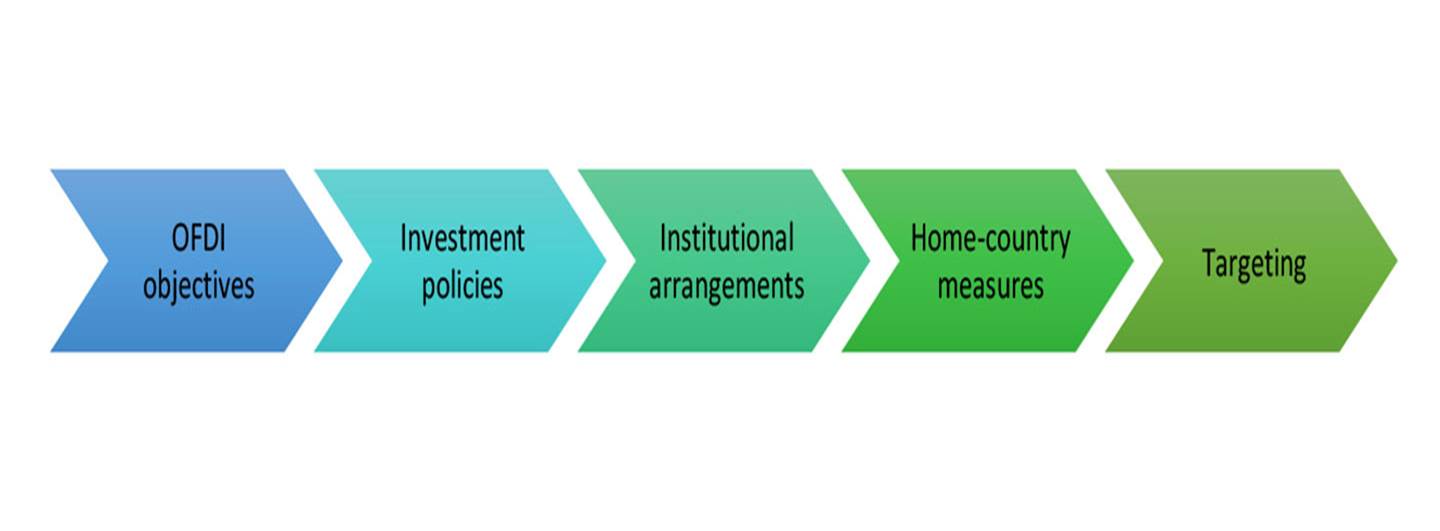
Finally, it is useful to seek alignment between the following five elements of OFDI policy, as illustrated in Figure 7:
(1) A country’s OFDI objectives and the home-country effects its government would like to focus on (see Section A: Home-country effects). This should correspond with the economic and context-specific circumstances of the country, its national development strategy, position on the IDP and national SDG roadmap or policy.
(2) Other investment policies of a country, such as those concerning inward foreign direct investment and domestic investment.
(3) Institutional arrangements, i.e., assigning responsibilities for OFDI to the appropriate institutions within a country, which would then undertake regulatory, facilitation, support and promotion functions associated with OFDI (see C1) Institution).
(4) The selection of HCMs in line with the country’s position on the OFDI policy path and taking into account other relevant considerations, such as country circumstances, broader development goals and affordability.
(5) The targeting of OFDI towards particular types of firms or investment activities (see Section D: Targeting). Such targeting should take into account the influencing factors known to trigger home-country effects that the government is focusing its efforts on (see Section B: Influencing factors).
Figure 7 OFDI policy alignment
Source: Stephenson (2018a)
Governments can use the Toolkit to achieve such an alignment and formulate corresponding OFDI strategies, policies and action plans.