How to use this Toolkit
The OFDI Policy Toolkit for Sustainable Development is divided into the following six distinct sections:
Section A: Home-country effects
This section categorises and examines eleven home-country effects based on a thorough survey of the available literature and research findings, and links them to the SDGs.
Section B: Influencing factors
This section categorises and examines ten factors that have been found to influence the intensity of home-country effects, based on a thorough survey of the available research findings.
Section C: Home-country Measures
This section examines ten categories of HCMs based on insights from the literature and a detailed survey of such measures in advanced and developing countries.
Section D: Targeting
This section examines ten options for targeting HCMs at specific companies or investment activities, based on insights from the literature and a detailed survey of targeting approaches in advanced and developing countries. These ten targeting options are the same sub-categories as the influencing factors in section B.
Section E: Potential risk factors
This section examines three potential challenges that could emerge from OFDI, based on a thorough survey of available literature and evidence.
Section F: Analytical tool
This section provides an analysis of common combinations of home-country effects, influencing factors, HCMs and targeting options, arising from sections A to D. It analyses how HCMs can be targeted at those companies and investment activities that are, at the same time, factors influencing the intensity of home-country effects. (A detailed explanation of how this analysis is conducted is provided further below and in the introduction to section F.)
Accordingly, each of these six sections contains a series of sub-sections, one for each home-country effect, influencing factor, HCM, targeting strategy, risk factor or combination, respectively. Moreover, each of these sub-sections contains the following information:
Each sub-section of the Toolkit begins with an explanatory description of the sub-category covered, discussing associated aspects and issues of importance.
This is followed by key insights summarising the emerging lessons learnt from the examination of the particular sub-category and associated collection of information, research findings and practices. The key insights also offer policy recommendations that can be derived from such emerging lessons.
Next is a list of interactions, indicating how the sub-category examined in the particular sub-section interacts with other sub-categories of the Toolkit. It is these interactions that inform the specification of viable combinations in section F.
A list of available research findings (for home-country effects, influencing factors and risk factors) and a list of existing practices (for HCMs and targeting strategies) is provided subsequently. Each item of evidence or practice listed contains a brief description and direct link to the original source. Research findings are organised by year, with the most recent study first. Existing practices are organised alphabetically by country.
In addition, there is an introductory section at the beginning of the Toolkit, explaining the background and purpose of the Toolkit and how it can be used. A final section sets out some OFDI principles that result from the key insights provided in the Toolkit.
The Toolkit employs colour coding to indicate a degree of confidence one could have in each key insight or interaction provided, based on the extent of available evidence, the extent to which a practice is observable, or theoretical plausibility. It can be read as shown in Table 1:
Table 1 Colour coding
| Dark green | Empirical evidence is strong based on multiple studies, or the practice has been observed repeatedly. |
| Light green | There is some empirical evidence (at least one study), or the practice has been observed at least once. |
| Yellow | In the absence of empirical evidence or observations of existing practices, the insight or interaction is theoretically plausible. |
| Red "!" | The effect is associated with potential risk factors and negative outcomes. |
There are six distinct ways in which the Toolkit can be used:
1. The Toolkit can be used as a knowledge source on home-country effects and HCMs.
The Toolkit is a large repository of resources, knowledge and data on OFDI, and its associated home-country effects and HCMs. It is a kind of ‘digital library’ collection of empirical evidence on home-country effects and existing practices in the adoption of HCMs. This repository is openly accessible to anyone and can be drawn on by government officials, policymakers, academics, researchers, analysts, lawyers, company managers etc. for their own specific professional purposes. In particular, government officials can draw information that informs their policy choices on how to nurture home-country effects for sustainable development through appropriate HCMs, while researchers and academics will find the Toolkit valuable for further research on this subject area.
For sections A, B and E, the ambition has been to include all available good empirical studies. To be included in the Toolkit, studies had to be of sufficient ‘quality’, which usually meant that they had to be published in a peer-reviewed format or otherwise have strong standing in the field. Relevant studies are listed under each sub-category for which they are relevant and may therefore appear several times in different sub-sections, together with a relevant brief summary and a direct link to the original study.
Users of the Toolkit should keep in mind the following issues when surveying the empirical
evidence:
- The number of studies found varied substantially between sub-categories of home-country effects and influencing factors. For some home-country effects, significant research has yet to be undertaken, while there are many studies on other effects.
- Empirical studies tend to be published when there are concrete findings to report, and research that found no home-country effects may potentially be under-reported. In some instances, home-country effects may not yet be realised, such as when capital outflows from a country being studied are limited. When capital outflows are limited but home-country effects do exist, they may sometimes not be substantial enough to be picked up by the statistical tools available to researchers. However, overall, the large number of studies in many sub-categories offer strong support for the existence of many home-country effects.
- The issue of causality is often a challenge in quantitative studies, resulting in uncertainty whether OFDI indeed has an impact in the home country, or whether it is the supposed effect that actually causes OFDI to increase. Most studies have demonstrated causality from OFDI to the home-country effect through appropriate statistical tests.
- A disproportionately large share of studies focuses on Chinese OFDI, given its phenomenal growth in recent years and an explicit Chinese ambition to use OFDI to support home-country development. Yet, there are also a considerable number of studies from other countries, both advanced and developing.
- Some studies examine multiple countries, others just one country. These two approaches were treated equally in terms of importance of the evidence, as both have strengths and weaknesses. Multiple-country studies have a larger sample, but single-country studies are often stronger in terms of detail and methodology.
For sections C and D, the ambition has been to include a wide selection of HCMs adopted by governments in both advanced and developing countries, based on a set of specified criteria. A reported HCM is usually publicly accessible and in operation at the time of inclusion into the Toolkit. The listed HCMs cannot be expected to be comprehensive, given the large number of countries that potentially have HCMs, the large number of HCMs in existence and the fact that such measures are not always fully published. Overall, the ambition has been to create a large repository of HCMs, which is continuously updated and expanded.
Users of the Toolkit should keep in mind the following issue when studying the existing practices in the adoption of HCMs:
- As policies and measures are constantly evolving in different countries, there is no guarantee that information on HCMs will always be fully accurate and up to date. Users of the Toolkit who require fully accurate and up to date information should verify this by consulting the original source provided through the direct link or contacting the relevant government for official confirmation.
2. The Toolkit can be used as an educational resource.
The Toolkit can be used to educate and inform individuals and governments about OFDI, its home-country effects and associated policies and HCMs. Users have, in the Toolkit, a comprehensive resource through which they can familiarise themselves with these subjects and acquire knowledge about the various issues and facets relevant to each sub-category in the Toolkit.
Each sub-section of the Toolkit provides an explanation and description outlining what is important to know and understand about the sub-category covered in that sub-section. These explanations and descriptions are kept brief and concise. For users who would like to gain a deeper understanding of a sub-category and study it in greater detail, references to further literature and resources are provided, usually with direct links to the original sources.
The Toolkit is therefore a valuable resource for technical assistance and capacity-building activities organised and run by governments and international organisations. The explanations and descriptions can be used to explain and discuss OFDI, home-country effects and HCMs in workshops, courses and seminars, with the linked literature functioning as resources for further study. The resources that the Toolkit provides as a whole can be drawn on to explore appropriate OFDI policies and measures at such events, including at (intergovernmental) meetings, and can be used to develop exercises for training courses. The Toolkit provides ample resources for the preparation of technical assistance material, such as studies of particular countries or issues for individual governments or organisations.
3. The Toolkit can be drawn on to acquire country-specific information.
While the Toolkit is organised by issue and sub-category, its online version has a feature that allows sorting the information available in the Toolkit by country. This feature provides all available empirical evidence on the home-country effects concerning a chosen country, the observed influencing factors and potential risk factors in that country, and the HCMs and targeting strategies adopted by the country’s government.
This feature is valuable for users who focus on obtaining information on one particular country only, including the impact of the country’s OFDI and its associated policies and measures. It should be particularly useful for governments, both for assessing the situation in their own country and as a benchmark of comparison to other countries. This feature can also be used to identify what HCMs are available from the home country to inward investors into a country. Firms in a particular country can also use this feature to find out of what HCMs they can avail themselves for their outward investments. This is also useful for the preparation of country-specific analyses and studies, for example as part of technical assistance activities.
4. The aggregate findings of the Toolkit can inform policymaking.
The wide range of empirical evidence and government practices on OFDI, home-country effects and HCMs collected in the Toolkit makes it possible, through the analysis of this data, to aggregate findings and derive key lessons learnt that can inform policymaking. Specifically, the Toolkit aggregates information and data in the following areas:
- It collates quality studies on home-country effects and influencing factors. This makes it possible to aggregate evidence on the extent to which particular home-country effects and influencing factors occur, and to assess the strength of the available evidence. Such analysis is vital for policymakers, as the key lessons can inform them on which home-country effects and influencing factors they should focus their OFDI policies and measures. These insights are valuable policy advice for governments.
- The Toolkit collates a wide range of government practices in the adoption of HCMs and the targeting approaches employed by governments. This makes it possible to examine what types of government practices are common, and to evaluate which of these might reasonably be conceived as ‘good’ or ‘best’ practices. Such analysis is vital for policymakers, as the key lessons can inform them about the HCMs and targeting strategies that are most promising and recommended for adoption. These insights are valuable policy advice for governments.
- The Toolkit collates available evidence on potential risks of OFDI for the home country. This evidence, and the key lessons learnt from it, can alert policymakers to potentially negative implications from OFDI and help them to ascertain which policies and measures could be adopted that promise to promote positive home-country effects. These insights are valuable policy advice for governments.
5. The Toolkit’s analysis of combinations offers new kinds of policy advice.
Finally, the Toolkit offers a unique analysis of combinations across sections A to E. For this analysis, the interactions between sub-categories of the Toolkit were determined. Specifically, this process determined which influencing factors affect (i.e., interact with) which home-country effects, and which HCMs are targeted at (i.e., interact with) which types of companies or investment activities. Since influencing factors are also either types of companies or investment activities (such as entry mode, investment destination or investment size), governments can effectively target HCMs at influencing factors that determine the strength of any home-country effects. To account for this overlap, the sub-categories for section B (influencing factors) and section D (targeting) were made identical. The potential interactions are shown in Table 2.
Table 2 Illustration of combinations across sections
Sub-categories in each column can potentially interact with sub-categories in adjacent
columns
| Home-country effects | Targeting influencing factor | Home-country measures |
| (section A) | (sections B and D) | (section C) |
| Financial earnings | Company characteristics | Institutions |
| Exports and production | Industrial sector | Regulations |
| Domestic investment | Investment motivation | Early support services |
| Know-how/technology | Investment size | Financial support |
| Improved standards/practices | Entry mode | Fiscal support |
| Industrial upgrading | Investment destination | Political risk insurance |
| Productivity | Absorptive capacity | Treaties |
| Resources capacities | Transmission channels | Operational support |
| Tangible assets/products | Time since investment | Maximising benefits |
| Employment | Home-country characteristics | Evaluation |
| Economic growth |
Many of the HCMs listed in the right-hand column of Table 2 can target many of the influencing factors listed in the middle column. Many of these influencing factors will in turn intensify the realisation of several home-country effects listed in the left-hand column. Thus, if home-country measures target the right influencing factors, they can nurture or maximise those home-country effects that are positively affected by these influencing factors. This is shown graphically in Figure 8.
Figure 8 Interactions of HCMs,
targeting (influencing factors) and home-country effects
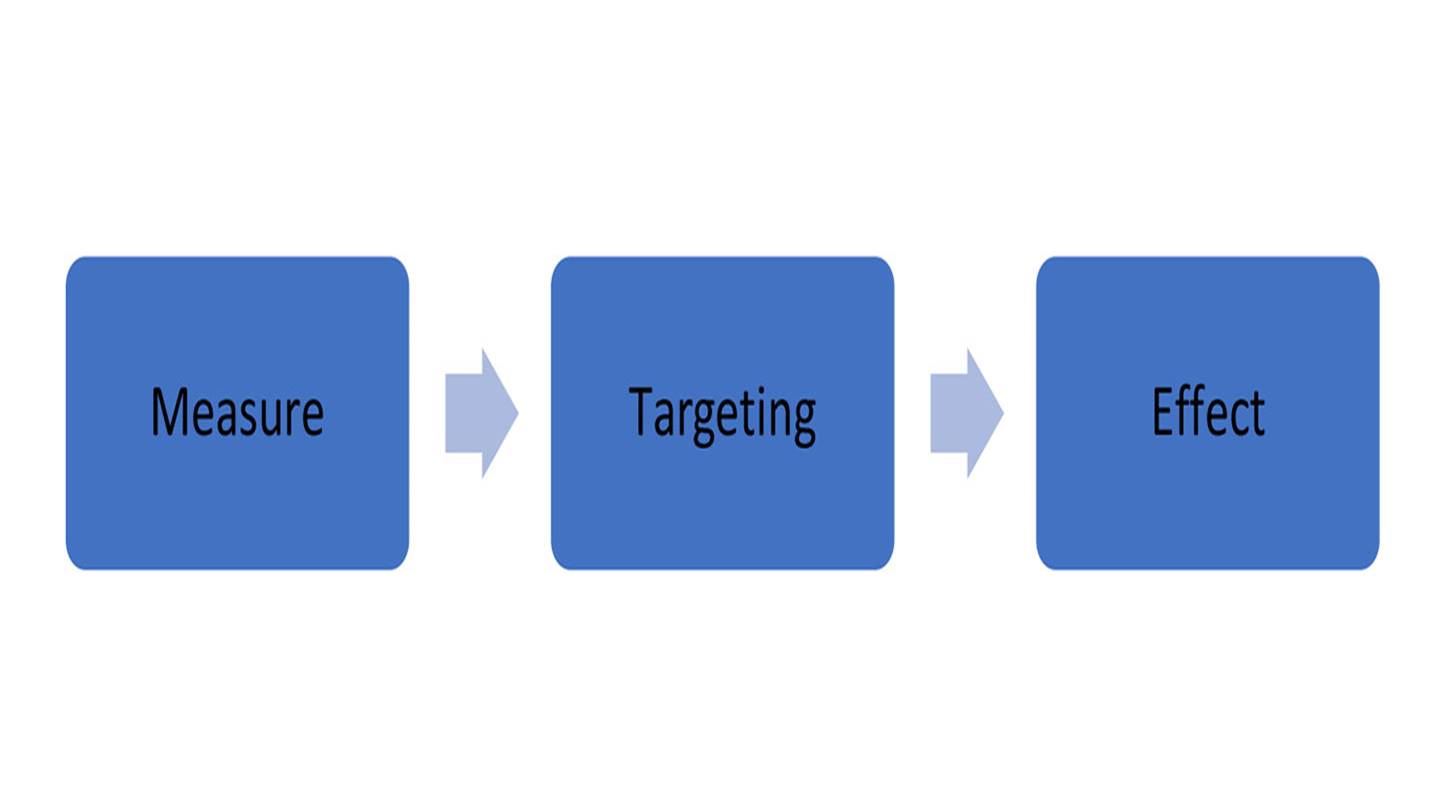
In section F, the Toolkit identifies such combinations. It presents the influencing factors that have been demonstrated by the empirical evidence to intensify specific home-country effects, and then examines which HCMs have been used to target these influencing factors or promise to be useful for such targeting.
Through this analysis of interactions between sub-categories of the Toolkit across individual sections, the Toolkit generates new policy advice on the following issues:
- The combinations across individual sections of the Toolkit generate unique insights on how governments can use HCMs to target those companies and investment activities that are also factors positively influencing the extent of home-country effects. These insights can be then turned into concrete policy advice for governments and policymakers on how to nurture and maximise the home-country effects from OFDI, based on the best available evidence and information from across the sections of the Toolkit.
- The bilateral interactions between two sub-categories by themselves offer useful insights on how HCMs can be targeted at specific companies and investment activities, and how the type of company or investment activity can affect the generation of home-country effects. These insights on interactions can be built into corresponding policy advice.
Despite the large variety of information and analytical tools, it should be noted that every country and economy is unique, and there is not guarantee that a particular HCM or policy approach adopted by a particular government will lead to the anticipated outcomes or home-country effects. While the Toolkit provides some guidelines, policymakers need to use their own judgements on which HCMs and targeting strategies to adopt, and monitor effectiveness to dynamically fine-tune their approach.
6. The Toolkit presents OFDI principles.
Finally, the Toolkit aggregates its insights and findings into a set of OFDI principles that governments can draw on to calibrate their approaches to OFDI, and to use OFDI to nurture and maximise the sustainable development gains for the home country. These principles can be incorporated into policy advice provided to governments.